Call for Papers
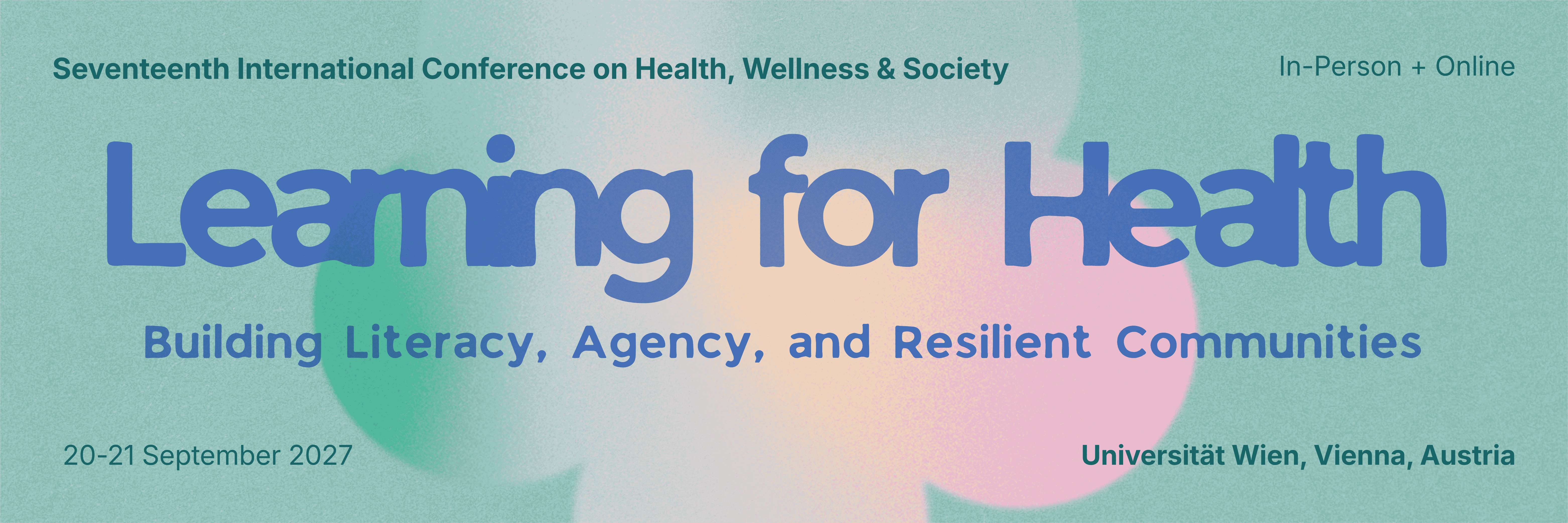
We invite you to join us for the Seventeenth International Conference on Health, Wellness & Society, the annual meeting of the Health, Wellness & Society Research Network, held at the Universität Wien, taking place in Vienna, Austria, and online, 20–21 September 2027.
Founded in 2011, the Health, Wellness & Society Research Network is a leading international meeting place for researchers, educators, health professionals, policymakers, and community practitioners working across the biological, psychological, social, institutional, and environmental dimensions of health and well-being. The Conference welcomes proposals that address health not only as a clinical or biomedical concern, but as a social, cultural, educational, environmental, institutional, and community practice.
Across the world, health is being reshaped by digital platforms, social networks, artificial intelligence, public-health crises, climate-related risks, institutional pressures, structural inequalities, and changing forms of community life. Key issues include health literacy, misinformation, access to care, public trust, health education, mental health, social connection, community resilience, professional and community knowledge, and the responsibilities of institutions in rapidly changing health environments.
Special Focus
The 2027 special focus, Learning for Health: Building Literacy, Agency, and Resilient Communities, invites participants to examine how people and communities develop the knowledge, capabilities, and collective resources needed to navigate rapidly changing health environments.
Health knowledge is no longer produced or encountered only within clinical and educational institutions. People increasingly learn about health through digital platforms, social networks, workplaces, community organizations, public campaigns, and AI-mediated information environments. These settings can expand access to knowledge and care, but they can also reproduce inequality, amplify misinformation, and make it more difficult to identify trustworthy and actionable guidance.
Health literacy must therefore be understood as more than an individual capacity to locate and interpret information. It also concerns how effectively institutions communicate, whether people can act upon the knowledge available to them, and how communities build shared capacities for care, preparedness, and well-being.
This special focus asks how learning can strengthen health agency without placing responsibility solely upon individuals. How can education strengthen health literacy, agency, and collective well-being? What forms of learning help individuals and communities respond to health misinformation? How are digital platforms and artificial intelligence reshaping access to health knowledge? What responsibilities do healthcare, educational, governmental, and media institutions have for producing understandable and actionable information? How can health education address structural inequalities without transferring responsibility for systemic problems to individuals? How can learning support preparedness for public-health emergencies, climate-related risks, displacement, and social disruption?
We welcome theoretical, empirical, professional, and practice-based contributions addressing health as a field of learning, care, institutional responsibility, public communication, community resilience, and social change.
Themes
- Theme 1: The Physiology, Kinesiology, and Psychology of Wellness in Its Social Context: This theme explores the physiological and psychological dimensions of health and well-being within their social contexts. Areas of interest include physical activity, mental health, disability, aging, health behaviors, wellness assessment, fitness, self-esteem, intervention programs, and cultural or media representations of bodies and health.
- Theme 2: Interdisciplinary Health Sciences: This theme brings together research and practice across medicine, nursing, pharmacy, dentistry, psychology, physical therapies, dietetics, social work, counseling, sports science, and related fields. It includes health technologies, personalized medicine, genomics, chronic disease prevention, biomedical aging, regenerative medicine, complementary health practices, and interdisciplinary models of care.
- Theme 3: Public Health Policies and Practices: This theme examines public health systems, policies, infrastructures, and community practices. Areas of interest include disease prevention, health equity, environmental and occupational health, food policy, public-health communication, healthcare reform, poverty, exclusion, urbanization, child and infant health, vaccine access, emerging risks, and the social determinants of health.
- Theme 4: Health Promotion and Education: This theme considers how health knowledge and practices are developed across schools, workplaces, healthcare settings, families, digital environments, and communities. Areas of interest include health literacy, health curricula, web-based education, wellness coaching, nutrition, occupational health and safety training, institutional influences on well-being, spirituality, quality of life, and access to health information.
We also welcome proposals addressing the core themes of the Health, Wellness & Society Research Network, including the physiological, psychological, social, institutional, policy, educational, and community dimensions of health and well-being.
Knowledge Experience and Format
The conference is organized as a hybrid knowledge experience, integrating in-person and online participation within a unified scholarly environment.
For in-person delegates in Vienna, the conference is designed as a human-scale gathering shaped by conversation, shared inquiry, and place-based exchange. Sessions, talking circles, breaks, and informal encounters create opportunities to connect health research with education, professional practice, public policy, community knowledge, and the real-world systems that shape health and well-being.
For online delegates, the conference is more than a remote viewing option. Accepted proposals become Presentation Pages where presenters share abstracts, media, and supporting materials. Delegates participate through live online sessions, asynchronous engagement, and discussion spaces that remain available before, during, and after the event.
Across both formats, the emphasis is on reciprocal exchange rather than one-way presentation. Whether joining in Vienna or online, participants are part of a shared knowledge environment where ideas can be presented, discussed, revisited, and developed into future collaborations, publications, policy conversations, professional practices, and community initiatives.
Language of Participation
The Health, Wellness & Society Research Network supports bilingual participation in English and Spanish. Presenters may submit proposals and present in either language, whether participating in person or online.
Publication Pathways
Presenters are invited to further develop their conference work for possible publication in The International Journal of Health, Wellness, and Society, the peer-reviewed journal of the Health, Wellness & Society Research Network.
Participants may also propose longer-form projects for the Health, Wellness & Society Book Imprint, which publishes monographs and edited collections focused on health, wellness, society, care, public health, health education, community well-being, institutional practice, and social change.
All accepted proposals are included in the conference proceedings, providing a formal record of the conference program and presentation abstracts. Proceedings help make presenters’ work discoverable as part of the annual knowledge record of the Research Network.
A Member-Based Research Community
The Health, Wellness & Society Research Network is a member-based international research community connecting people who work across the biological, psychological, social, institutional, and environmental dimensions of health.
Membership provides year-round opportunities to participate in the life of the Research Network through conferences, publications, digital resources, and the CGScholar Community. Members receive access to Research Network content and publications, conference registration benefits, opportunities for continued learning and exchange, and pathways for developing and sharing their work.
The Community provides a space for members to maintain profiles, share projects, engage with other participants, revisit conference programs and recordings, and contribute to continuing conversations across the Research Network.
Membership in the Health, Wellness & Society Research Network is included in all conference Presenter Passes.
Join Us
We warmly invite you to submit a proposal and join us, either in Vienna or online, for the Seventeenth International Conference on Health, Wellness & Society.
Together, we will examine how health knowledge, education, institutions, and communities can strengthen literacy, agency, care, and resilience in changing health environments.
Sincerely,
Dr. Louise Dalingwater, Research Network Chair, Sorbonne Université, Paris
Dr. Angelica Avendaño Veloso, Research Network Chair (ES), Universidad de Concepción, Chile
Dr. Phillip Kalantzis-Cope, Chief Social Scientist, Common Ground Research Networks, United States of America